My buddy texted me about his new podcast last month. Had this $40 USB mic from Amazon—4,000 five-star reviews, must be good right? Sounded like he was broadcasting from inside a soup can. Back to Amazon it went.
Here's what nobody tells you about podcast audio: your voice is literally the entire product. Blog posts can lean on formatting. Videos have visuals. Podcasts? Just your voice bouncing around in someone's earbuds. The gap between a $99 mic and a $40 one isn't subtle.
I've messed around with maybe 15 different mic and interface combos over two years. Figured out where the money actually matters. Spoiler: not at the expensive end. That $150-300 range? That's where you start sounding better than half the shows on Spotify.
If you're skimming: Samson Q2U for starting out with USB simplicity. Focusrite Scarlett Solo paired with a Rode PodMic when you're ready to do this properly.
Quick Picks
| Kit | Best For | Price | Connection |
|---|---|---|---|
| Samson Q2U | Budget/Beginners | $99 | USB + XLR |
| Scarlett Solo + PodMic | Serious podcasters | $249 | XLR |
| MOVO PodPak-2 | Two-person shows | $199-330 | XLR |
What You Actually Need
Most beginners overcomplicate podcast gear. Let's simplify.
You need:
- A mic (duh)
- Something connecting it to your computer
- Headphones so you can hear yourself
- Probably a boom arm unless you enjoy hunching over a desk
That's literally it. Skip the mixer. Skip covering your walls in foam. Skip the $500 microphone. Just get something that grabs your voice without also grabbing your mechanical keyboard, the neighbor's lawn care, or the HVAC kicking on.
Dynamic versus condenser mics—this actually matters. Condensers are touchy. Sound amazing in proper studios, sound terrible in apartments where you can hear traffic. Dynamics reject background garbage much better. For recording at home, dynamic almost always wins.
The Budget Champ: Samson Q2U ($99)
Been recommending this mic since 2021 or so. Still do.
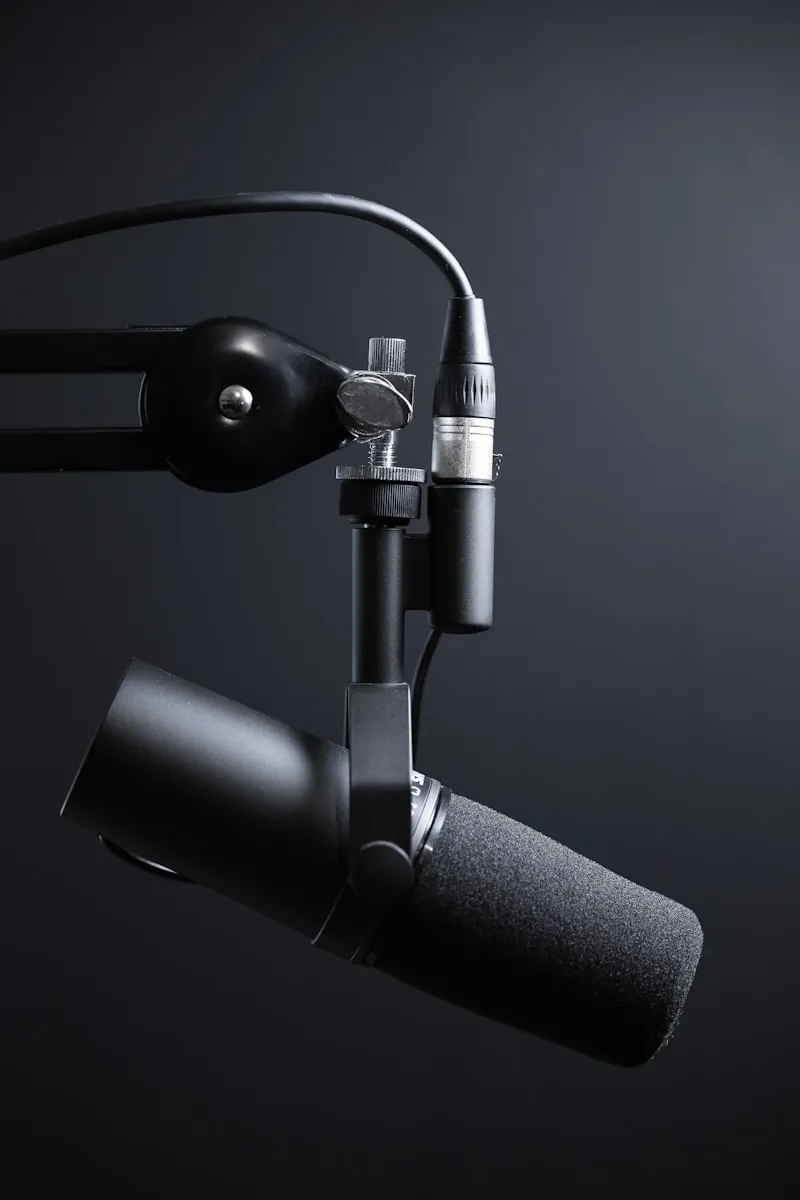
The Q2U pulled off something smart: USB and XLR outputs on the same mic. Plug it into your MacBook via USB right now. Buy an audio interface next year, switch to XLR. Same mic works for both.
Whole package runs about $99. You get the mic, stubby desktop stand, pop filter, both cables. Could record tonight if you wanted.
Sound quality? Maybe 80% of mics at double the price. For a podcast where people care about what you're saying more than pristine audio engineering, that's fine. Know several shows recorded on Q2Us pulling thousands of downloads.
Stuff I noticed testing it:
The annoying part:
Desktop stand is laughably short. You'll be leaning in like you're sharing gossip at a bar. Throw another $20-30 at a cheap boom arm.
Good fit for: People just starting. Those testing whether they'll actually keep podcasting. Anyone who'd rather record this week than research gear for a month.
Check Q2U on AmazonThe Smart Money: Focusrite Scarlett Solo + Rode PodMic ($239-279)
Know you're serious? Skip USB mics entirely. This is what I'd grab if I were starting over.
Scarlett Solo is Focusrite's smallest audio interface, and "entry-level" here means properly clean preamps in a box roughly the size of a paperback. Fourth gen version dropped recently. Got USB-C finally.
The PodMic costs $99 and was built specifically for voices. Pair them together and you've got gear that'll outlast your interest in podcasting.
Tested this setup against $400-500 combos. Hard to hear meaningful differences. PodMic punches way above that $99 price tag. Scarlett preamps just sound clean.
What the Scarlett Solo gives you:
The annoying part:
No headphones included. Add $50-80 for something like Audio-Technica ATH-M20x. And yeah, you'll want a boom arm too.
Math: Scarlett Solo Gen 4 is around $130. PodMic is $99. XLR cable maybe $15. Under $250 before you add a boom arm.
Good fit for: Podcasters planning to stick around more than a few months. Video creators who need mic audio. People who'd prefer sounding professional from episode one.
Check Scarlett Solo on AmazonAll-In-One Route: MOVO PodPak-2
Buying gear piece by piece getting tedious? Bundles exist. PodPak-2 is one I'd actually consider.
The bundle gets you: two dynamic mics, stands for both, dual-channel interface, all the cables, pop filters. Two people can start recording from one box. Nothing to research for compatibility.
Audio quality sits between the Q2U and Scarlett/PodMic territory. Interface preamps aren't as pristine as Focusrite, but miles better than random USB mics.
The dual-channel interface matters more than it sounds. Recording two hosts with independent gain controls? Actually important. Trying to solve that with multiple USB mics? Nightmare fuel.
The annoying parts:
Mics themselves don't match the PodMic quality. You're trading component quality for convenience. Desktop stands still too short—same complaint.
Good fit for: Two-host shows where budget matters. People who want one purchase and zero thinking. Anyone prioritizing "works together" over "best possible specs."
Check MOVO PodPak on AmazonDifferent Direction: Audio-Technica AT2020 + Scarlett Solo ($239)
The AT2020 is a condenser, not dynamic. Grabs more nuance but also more background noise.
Got a genuinely quiet space? Not some shared apartment with roommates? AT2020 delivers richer detail than dynamic mics at similar prices. Use one myself for voiceover stuff occasionally.
Real tradeoff though. Condensers are microphones for everything. My office sounds normal on dynamic. On the AT2020, my refrigerator two rooms over becomes a co-host. Room treatment stops being optional.
The annoying part:
Picks up noise you didn't know existed. Forces you to actually deal with your recording environment. Not grab-and-go.
Good fit for: Quiet home offices. Voiceover work doubling with podcasting. People willing to hang blankets or move furniture.
Check AT2020 on AmazonThose Suspiciously Cheap Amazon Bundles
You've scrolled past them. Full podcast kits for $89—mic, stand, pop filter, arm, some mystery interface from a company called like "ZINGYOU."
Bought three for science. Same issues across all of them:
- Interfaces with embarrassing latency (150+ milliseconds in your headphones)
- Mics that sound harsh and tinny regardless of settings
- Boom arms slowly drooping under the mic's weight
- Pop filters that don't actually filter pops
Reviews are either fake or from people who've never heard decent gear. Not being snobby—there's an actual quality floor these products can't clear. $99 Q2U trounces $89 bundle kits.
What Actually Affects Your Sound
Most spec-sheet stuff is marketing. Here's what genuinely matters:
Your room beats your mic
Recording in a closet with blankets draped around sounds better than a bare room with expensive gear. Hard surfaces bounce sound and create that amateur echo.
Technique beats equipment
Where you position the mic matters more than which mic you bought. Best mic badly positioned loses to mediocre mic positioned right.
Gain staging prevents noise problems
Proper levels make the difference between a $99 preamp and $500 preamp basically vanish. Most "bad equipment" complaints are actually user setup issues.
Editing catches the rest
Background hums, mouth clicks, volume spikes—software fixes these. Try free tools like Audacity before upgrading hardware.
Getting It All Working
Setup takes half an hour tops, even if you've never touched audio gear.
USB mic route (Q2U)
Plug USB cable into laptop. Pick the mic as your input source. Record. That's actually it.
XLR through an interface
USB from interface to computer. XLR from mic to interface. Headphones into interface headphone jack. Turn up gain until meters show movement without red lights. Select interface as input. Done.
Mic positioning
Put mic roughly 4-8 inches from your face, angled slightly rather than directly at your mouth. Cuts down on "p" and "s" harshness. Tweak based on what you hear in the headphones.
Questions People Always Ask
Frequently Asked Questions
Quick Summary
Under $150: Samson Q2U at $99, plus any cheap boom arm. Works right away. Upgrades later without replacing mic.
Around $250: Scarlett Solo, PodMic, XLR cable. My recommendation for anyone who knows they're doing this.
$300 for two people: MOVO PodPak-2 bundle. Components aren't premium but compatibility headaches disappear.
Skip: Cheap Amazon bundles, gaming headsets, Blue Yeti.
My friend swapped that $40 Amazon mic for a Q2U. First episode recorded that same week. Actually sounds like someone with a podcast now. And that's the whole point—sounding competent enough that listeners focus on your words instead of your equipment.